
Written by Nancer Ballard; ed. assistance by Savannah Jackson.
Until women can visualize the sacred female, they cannot be whole and society cannot be whole.
– Elinor Gadon
In late November in the United States, Thanksgiving is a holiday to celebrate the harvest and gratitude. Many of us also share food with people from other cultures and circumstances. The first “American” Thanksgiving was celebrated by 53 Pilgrims and 90 Native Americans in 1621. Thanksgiving was officially declared a federal holiday by Abraham Lincoln in 1863 during the American Civil War to express hope for an end in civil strife, and as a day of gratitude. Some Americans also observe American Thanksgiving as a day of mourning to commemorate genocide against Native Americans by United States settlers.
Not surprisingly, the United States was not the first to celebrate harvest feast days. The Canadians held October harvest feast celebrations years before the Pilgrims arrived, and the French and Spanish have been celebrating harvest feast days since at least the 16th century. Wisdom practices such as honoring female deities connected to nature, expressing gratitude, sharing, and giving, are integral to many indigenous cultures and communities.
Regardless of your geographical location or cultural identity, the season of harvest seems appropriate time for The Heroine’s Journey Project to review some of the year’s gifts. 
We appreciate the thousands of site visitors from around the world who read our blog posts, send comments and suggestions, and ask us questions. We are grateful for the essays, plays, books, and stories sent to us by our readers. In particular we’d like to give a shout out to Jean Marie Bishop who sent us her plays about Jeanette Rankin, the first woman to hold federal office in the United States when she was elected to the House of Representatives in 1916, and Mary Dyer, an American Puritan turned Quaker who was hanged in The Massachusetts Bay Colony in 1660 for defying Puritan law banning Quakers in the colony. We would like to give a shout out to Jody Gentian Bower, author of Jane Eyre’s Sisters; How Women Live and Write the Heroine’s Story who sent us an essay on the Heroine’s Journey; to Duda Dorea, who is translating The Heroine’s Journey Project site into Portuguese so that it can be more widely shared in Brazil, and Judah Quinn, a filmmaker in Australia who is making a documentary on five women’s experiences with the Heroine’s Journey in their lives. We are hoping to feature some of this work in the coming months.
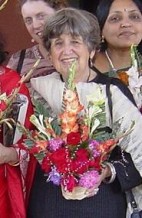 This year we are sorry for the passing of Elinor Gadon, cultural historian, Indologist, art historian, Resident Scholar at Brandeis University’s Women’s Studies Research Center. She is the author of The Once and Future Goddess; a visual chronicle of the sacred female and her reemergence in cultural mythology and was an exuberant student of the heroine’s journey throughout her long life. Filmmaker Megan McFeeley put together an excerpt from her two-hour interview with Elinor in 2000 for Elinor’s Celebration of Life at Brandeis. We hope to introduce you to Elinor Gadon’s and Megan McFeeley’s work in the near future.
Your most-requested items are the names of books, films, and stories that include a Heroine’s Journey. This fall we have begun to compile lists which we plan to add as permanent page to the site this spring.
Some of the books with heroine journeys that we’ve reviewed in the past year include:
Department of Speculation by Jenny Offill (fiction); 
Fun Home by Allison Bechdel (graphic novel, later made into a musical);
Far from the Tree by Andrew Solomon (non-fiction with many heroine journeys depicted in the descriptions of the lives of non-conventional families);
Lincoln’s Dressmaker by Jennifer Chiaverni (historical fiction);
Lila by Marilyn Robinson (fiction);
Once and Future King by T. H. White (the first portion of the book known to many as the story of The Sword in the Stone is a Hero’s Journey, but the book as a whole is a Heroine’s Journey);
Random Family: Love, Drugs, Trouble, and Coming of Age in the Bronx by Adrian Nicole LeBlanc (nonfiction); and
Chalice and the Blade; Our History, Our Future by Riane Eisler is not a heroine’s journey story but traces the origins of the descent of goddess worship and the psychological impacts of the denigration of female deities on men, women, and cultural values through archaeology, anthropology, history and religion.
Movies we have recently reviewed and plan to blog about in the future include:
Boys on the Side directed by Herbert Ross and starring Whoopi Goldberg, Mary-Louise Parker, and Drew Barrymore;
RBG, a 2018 American documentary directed by Betsy West and Julie Cohen, on the life and career of Supreme Court Justice Ruth Bader Ginsburg which includes both elements of the Hero’s Journey and Heroine’s Journey. RBG was chosen by the National Board of Review as the Best Documentary of 2018; and
The Death and Life of Marsha P. Johnson, the story of a Native American’s health worker’s search for the truth about the death of prominent transgender activist Marsha Johnson.
In the next few weeks look for an upcoming post on “Kicking the Stone,” a wonderful short story by Barbara Leckie in Salamander, one of the literary journals that’s one of the offerings from the Journal of the Month Club.
Later in the winter and spring we will be exploring work by Jean Marie Bishop, Elinor Gadin, and suffragist scholar, memoirist, and playwright, Pam Swing and her student playwright co-author, Elizabeth Dabanka. We are also seeking to interview several others working with the Heroine’s Journey in a variety of disciplines.
We will also be focusing on how the Heroine’s Journey can be applied to social activism and, hopefully, collaborating with others working on similar projects.
We would love additional suggestions from our site visitors. Send the name of a book, story or film with a sentence or two on why you think it follows the Heroine’s Journey and we will review it as we work to expand our lists. Meanwhile, may your lives be full and your burdens light.

This chalkboard mural by Coty can be found at the wonderful Green Goddess Cafe in Stowe, Vermont.
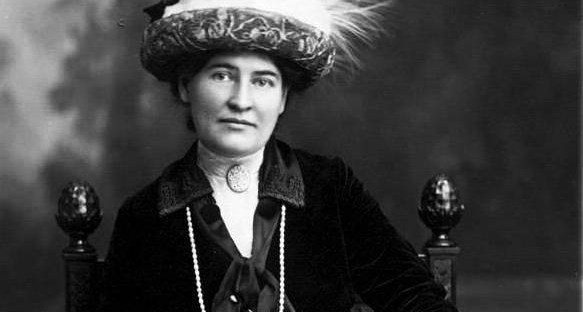
 Eden has wanted to an actress from the time she was very young and is convinced “that she would live far away in great cities, … be much admired by men and … have everything she wanted.” This vision guides Eden throughout her life and she accepts advice (such as changing her name from Edna to Eden) from anyone whom she believes can move her closer to international fame and adoration. She goes to New York, where she believes she is fated to find someone who will take her to Paris. In New York, Eden is for the first time momentarily free to do what she wants, when she meets Hedger who presents her with the opportunity for a new life perspective .
 In Coming, Aphrodite!, Cather presents her readers with a complex discussion of success. Both characters find the success they seek, and Cather is careful to present a neutral view. But by the close of the story one senses that her sympathies lie with the Heroine’s Journey.


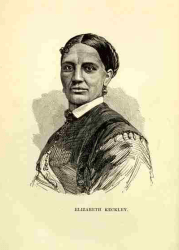 When Abraham Lincoln is elected President, First Lady Mary Todd Lincoln selects Keckley from among numerous applicants to be her personal “modiste.” As her modiste, Keckley has the responsibility for designing and creating the First Lady’s gowns and dressing her for important occasions. Mary Todd Lincoln is viewed as an outsider by Washington society women, and Keckley becomes the First Lady’s trusted confidante. If the story had ended here, it would be a hero’s journey arc – e.g., former slave overcomes great odds to become a member of the White House’s trusted staff through her own ingenuity and skill during the years in which Abraham Lincoln signed the emancipation proclamation. But Keckley’s life and Chiaverini’s story are more complex and don’t end with Keckley becoming a celebrated seamstress and Mrs. Lincoln’s confidante.
 Chiaverini chronicles Keckley’s post-White House life with the increasingly debt-ridden and mentally compromised Mrs. Lincoln. When the money runs out, Keckley tries to earn a living by writing her remembrances of her time in the White House, by writing her remembrances o her time in the White House, but is betrayed by her publisher. Although Keckley intends her portray Mrs. Lincoln with sympathy, the book causes a public outrage in large part because Keckley, an unschooled African American, has dared to give voice to her impressions o the inner workings of the White House. Moreover, her publisher ignores her instructions and adds the contents of Mrs. Lincoln’s confidential letters to Keckley. Not only does Keckley fail to earn any much-needed money from the book, she is scorned by the public and Mrs. Lincoln refuses forgive her, see her, or believe in her good intentions. The novel follows Keckley’s subsequent efforts to recover her life as an independent seamstress and her years as a dressmaking instructor in a college. When she suffers a stroke, she is gain without means and is forced to reside at the Home for Destitute Colored Women and Children a few blocks from the White House. Keckley endures a multitude of hopes and heartbreaks, and Chiaverini offers no “final” triumph (or failure).
 Mrs. Lincoln’s Dressmaker closes with an affirmation of the complexity and dignity of Keckley’s whole life, including her losses. Instead of focusing on Keckley’s unusual role in the White House, Chiaverini observes that “[Keckley] had lived a full and fascinating life. She had known the most remarkable people of the age, and she had never refused to help the humble and down trodden. Despite its disappointments and losses and heartbreaks, she would not have wished her life a single day shorter—nor, when the time came for her to join the many friends and loved ones who had gone on before her, would she demand an hour more.”
 The Heroine Journeys Project